
Approved publication retrieval
Designed for maintenance questions that should be answered from current manuals, procedures, task cards, and local references.
Voice-first retrieval for aviation maintenance teams.
A private MVP build for approved-publication retrieval, voice query, and source-cited maintenance guidance on phone, web, and wearable surfaces.
Operational shape
How the project supports decisions, context, and execution.

Maintenance work is physical, procedural, and time-sensitive. Asking technicians to stop, search, type, and translate a manual into the next action creates friction at exactly the wrong moment.
Maintenance Control is built around voice-first access to approved publications. The current private build includes a Next.js web console, an Expo iOS companion, shared contracts, publication ingestion, parser review, revision-aware retrieval, persisted sessions, media upload plumbing, and benchmark tooling.
The product is not trying to authorize maintenance actions. It helps maintainers find the right source-backed answer faster, keeps citations visible, and leaves a record that supervisors and admins can review.
The project is positioned as maintainer workflow software, not a generic chatbot wrapped around technical manuals.
The active build separates controlled content review, frontline query, and audit records so source grounding remains visible across web, phone, and wearable surfaces.
Maintenance Control keeps approved publications, scoped retrieval, voice input, answer composition, and audit records in separate parts of the system.
Screenshots from the current mobile companion show source readiness, an answered maintenance query, and hands-free voice capture.
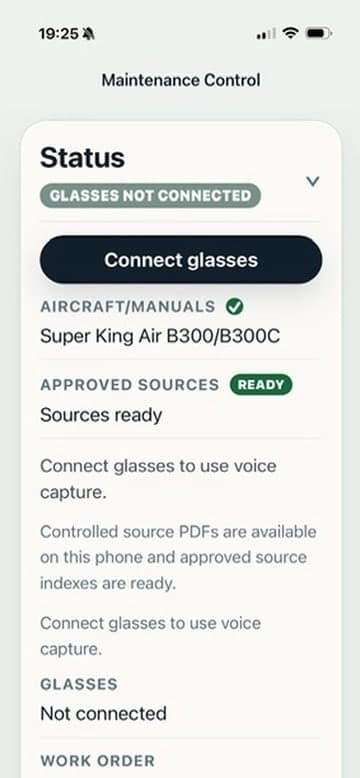
Source readiness
Shows the phone companion with a Super King Air B300/B300C context, approved sources ready, and glasses connection state visible.
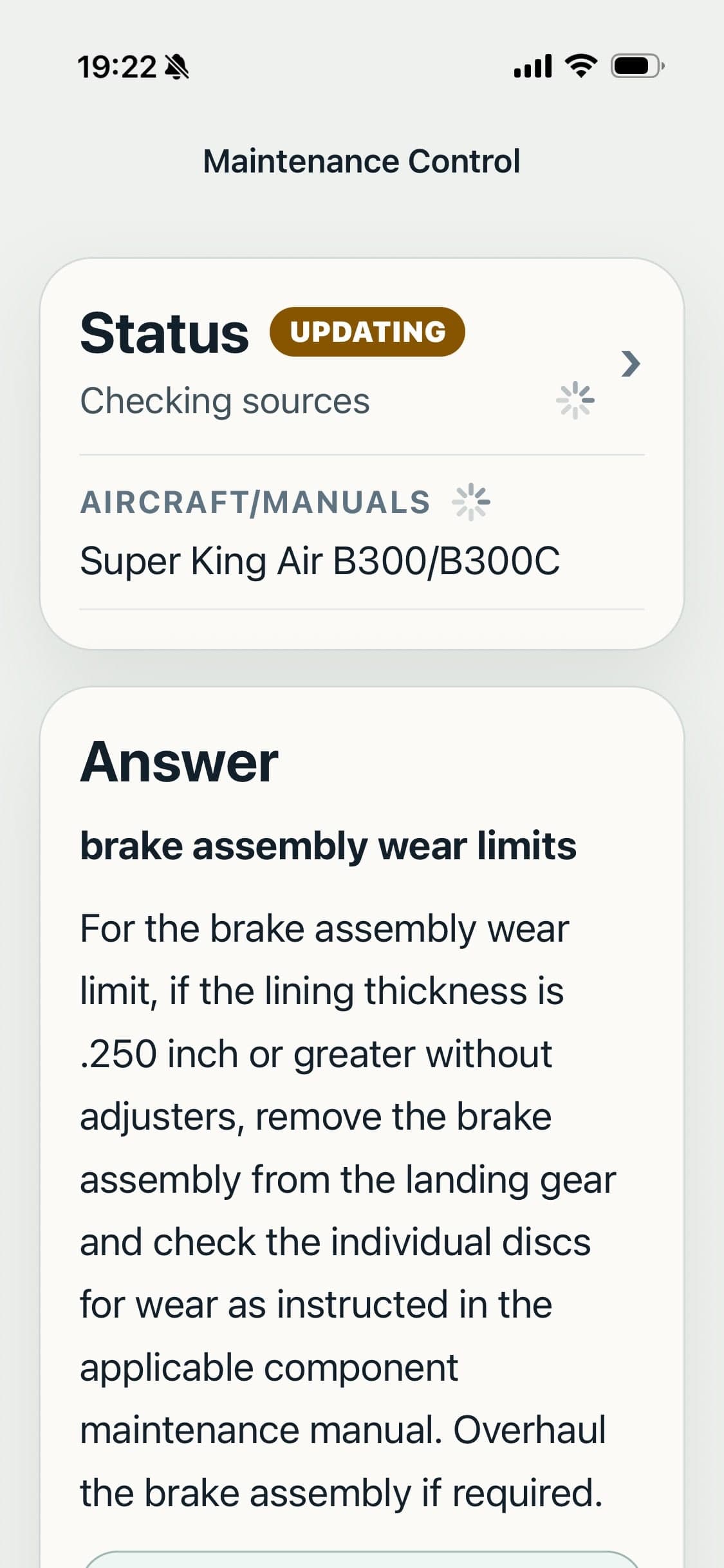
Answer state
Shows the mobile answer surface after a maintenance query. Citation and source cards are part of the answer payload and companion flow.
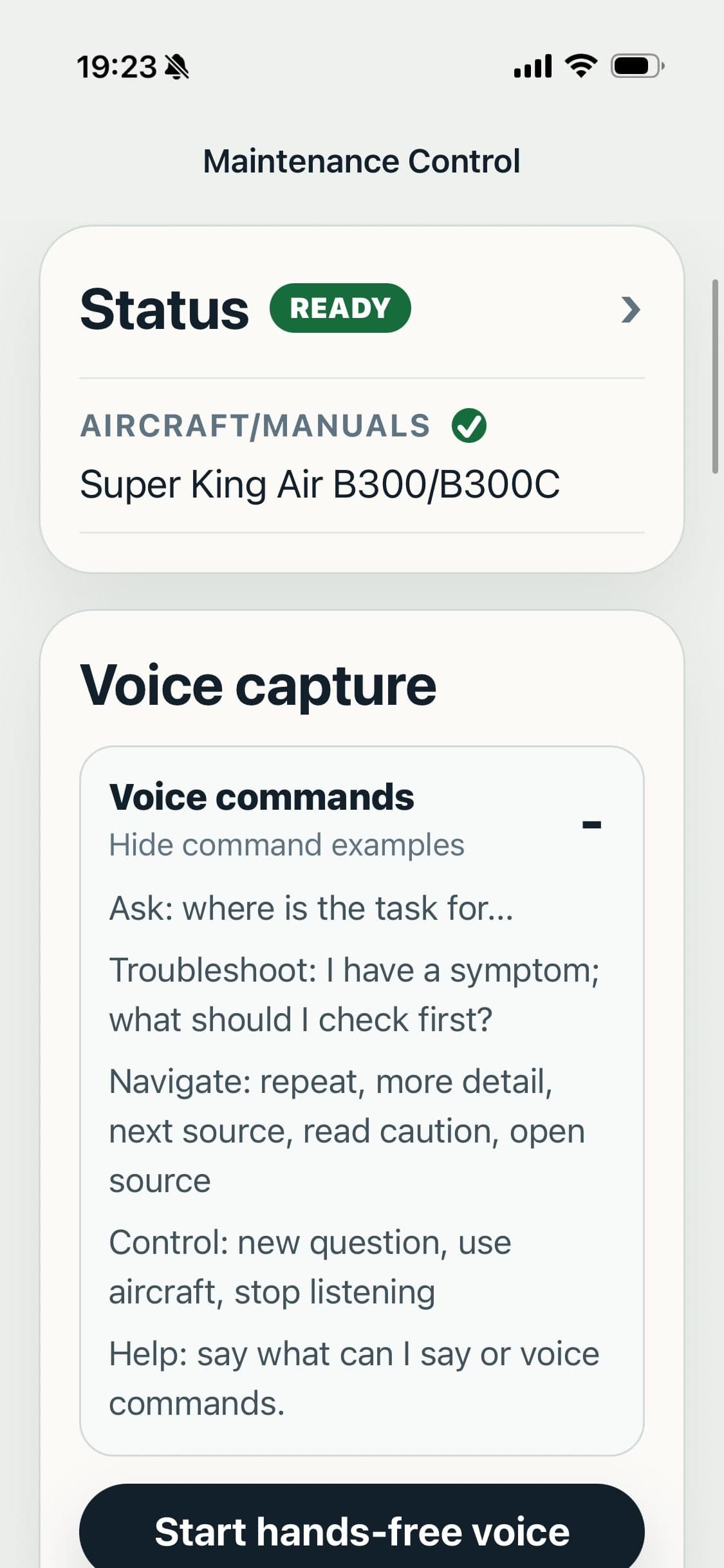
Voice capture
Shows the ready state, voice command examples, and the hands-free voice entry point on the mobile companion.
The useful evidence is in the implementation surfaces and the safety checks around retrieval, not in a polished audio demo.
Publication upload and activation flows keep reviewed revisions separate from draft or superseded content.
Queries filter to current approved revisions for the selected maintenance context before lexical and vector retrieval.
Answer payloads carry citations, source excerpts, related sections, support level, and abstention state.
Recorded voice, transcription, fallback behavior, and Realtime session seams are covered by scenario tests.
Sessions preserve transcript, retrieved chunk hits, citation order, excerpt offsets, answer text, user, device, timestamp, and diagnostics.
Retrieval benchmarks track Top-1, Top-3, citation correctness, abstain behavior, and unsafe wrong-manual cases.
These are the practical workflows and constraints the project is built around.
Designed for maintenance questions that should be answered from current manuals, procedures, task cards, and local references.
Uses phone and wearable surfaces for short questions, answer playback, media context, and source review when desktop software is the wrong surface.
Gives admins a place to manage publication intake, review parser output, activate revisions, and inspect query/session records.
The hard part is not speaking an answer through a headset. The hard part is making sure the answer comes from the right approved source, for the right aircraft context, with enough citation and session history for a supervisor or admin to review later.
Maintenance Control is an active private MVP build. The public page shows current implementation evidence; deeper repo access, transcript-based demos, or live walkthroughs can be shared with appropriate reviewers.
Different surfaces, same focus on context, coordination, review, and execution. This is a selected public view, not a complete project history.

AlignTrue is an open-source reference architecture for supervised AI systems that need durable receipts, replayable state, governed actions, and fenced side effects.

GlassAlpha is an open-source toolkit for deterministic audit reports for tabular ML models, with fairness, explainability, calibration, robustness, and reproducibility metadata in one local workflow.
Send the product, workflow, or modernization problem with enough context for Gabe to tell whether there is a serious build.